 English
 Español
China RV Adaptor Factory: How to Source Reliable 30A and 50A RV Adapters
Content
- 1 What an RV Adaptor Factory Actually Builds
- 2 Specifications That Decide Whether the Cord Passes
- 3 Load Planning: Gauge, Splitting and Real Current
- 4 Certification: The Paperwork Has to Match the Product
- 5 Five Procurement Risks That Appear After Delivery
- 6 Vetting a Factory Before the First Purchase Order
A distributor sends an RFQ for 5,000 RV adaptor cords: NEMA TT-30P male to 5-15R female, 12 inches, 10 AWG, retail bag. Three factories in Ningbo quote within eight percent of one another, and the samples look identical — same body, same color, same print. They are not the same product. One holds 30 A with a comfortable temperature rise, one softens at the molded body after twenty minutes at 24 A, and one carries a listing mark issued for a different plug configuration than the one in the box.
That gap is what you are really buying from a China RV adaptor factory. Price and catalog size tell you very little. Conductor gauge, blade and body tolerance, retention and strain-relief performance, and a certification file that names the exact model you ordered are what separate a repeatable supplier from a one-time quotation.
What an RV Adaptor Factory Actually Builds
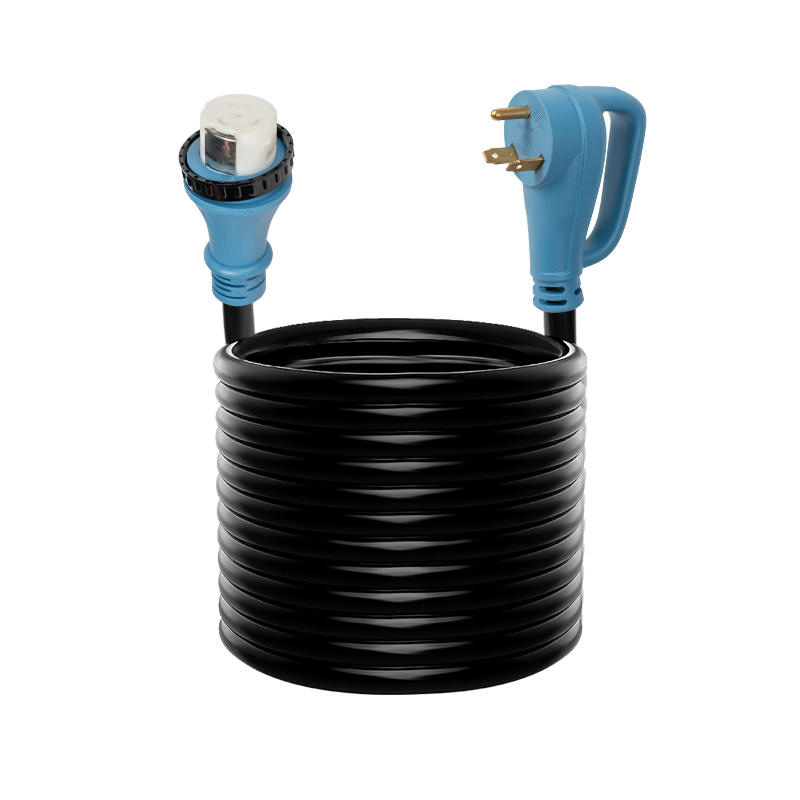
An RV adaptor is a short cord assembly — 1 ft to 25 ft in most catalogs — that changes plug standard, current rating or both. The configurations are standardized: NEMA TT-30P for 30 A/125 V RV service, 14-50P for 50 A/240 V, L5-30 and L6-30 locking plugs for generator and marine use, 5-15R and 5-20R household receptacles, and SS2-50 for heavier shore power connections.
Because these products share tooling — copper stranding, terminal crimping, injection-molded PVC or rubber bodies — a factory that molds RV adaptors normally runs generator cords, extension cords and power inlet boxes on the same lines. That overlap decides how fast a volume order moves: the real constraint is capacity for 10 AWG three-conductor assemblies, not the number of molds on the floor.
- RV and campground adaptors
- Pedestal conversion: 50 A to 30 A and 30 A to 50 A dogbone adaptors
- Household conversion: TT-30P to 5-15R, 5-15P to SS2-50R
- Generator to RV: L14-30P to TT-30R, four-prong 30 A adaptors
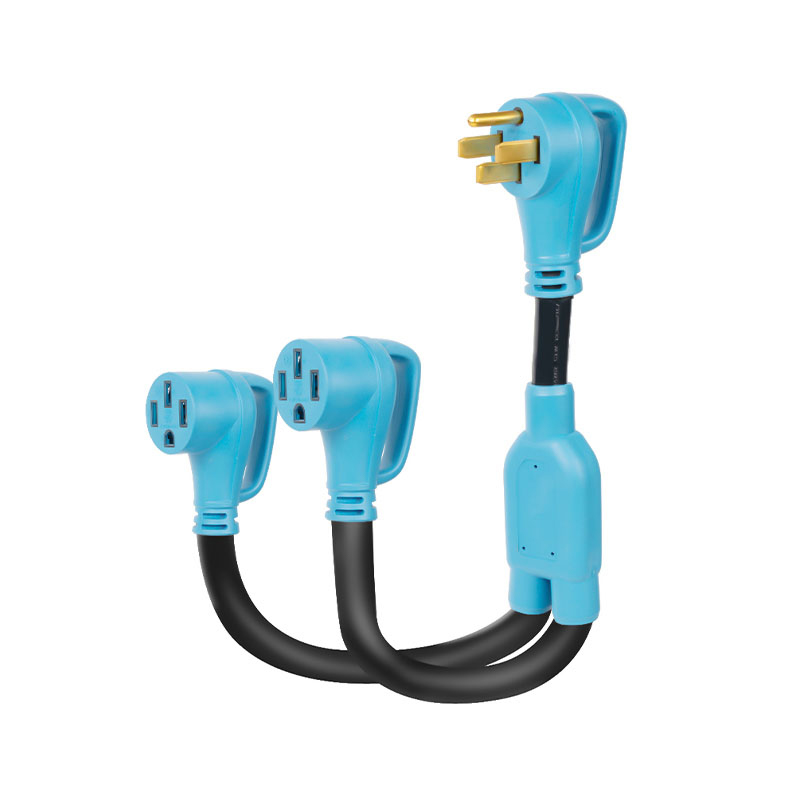
- Distribution: 14-50P to four 5-15R/5-20R, L5-30P to three 5-15R
- Y splitters: 14-50P Y and TT-30P Y for two loads on one outlet
- Towing: 7-way inline trailer plug extensions
- Marine shore power: L5-30 yellow 25 ft cables
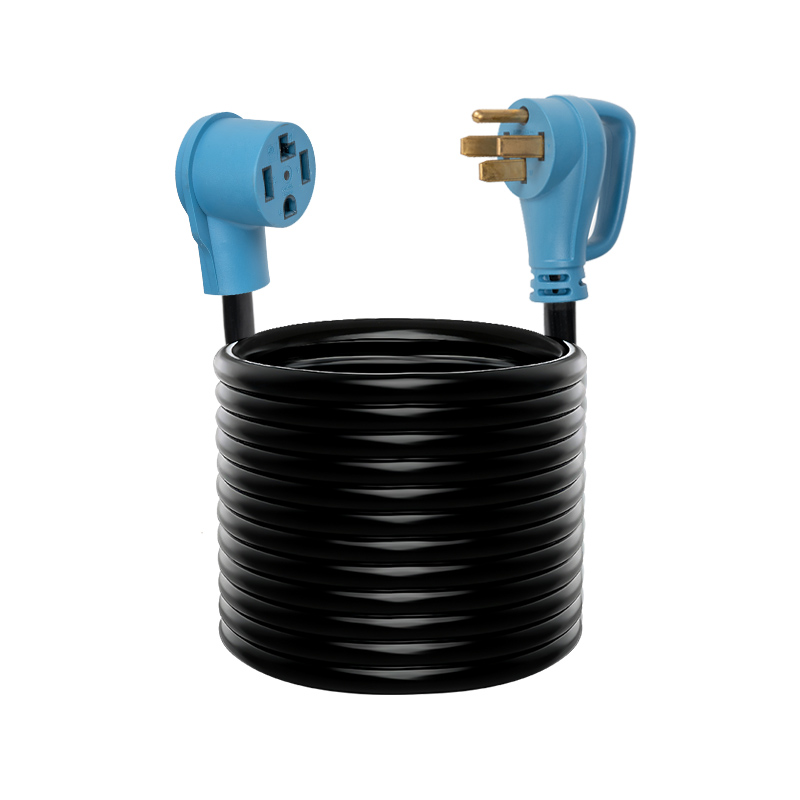
The most requested item in the family is still the pedestal dogbone. A 30 A trailer parked at a 50 A site needs a step-down; a 50 A coach at a 30 A site needs a step-up. Both look trivial, and both are where undersized copper shows up first, because a very short cord handles full branch current with almost no surface area to dissipate heat. Catalog depth matters as well: a supplier with a genuine RV adaptor range will hold step-up, step-down, splitter and distribution variants under the same listing scope.
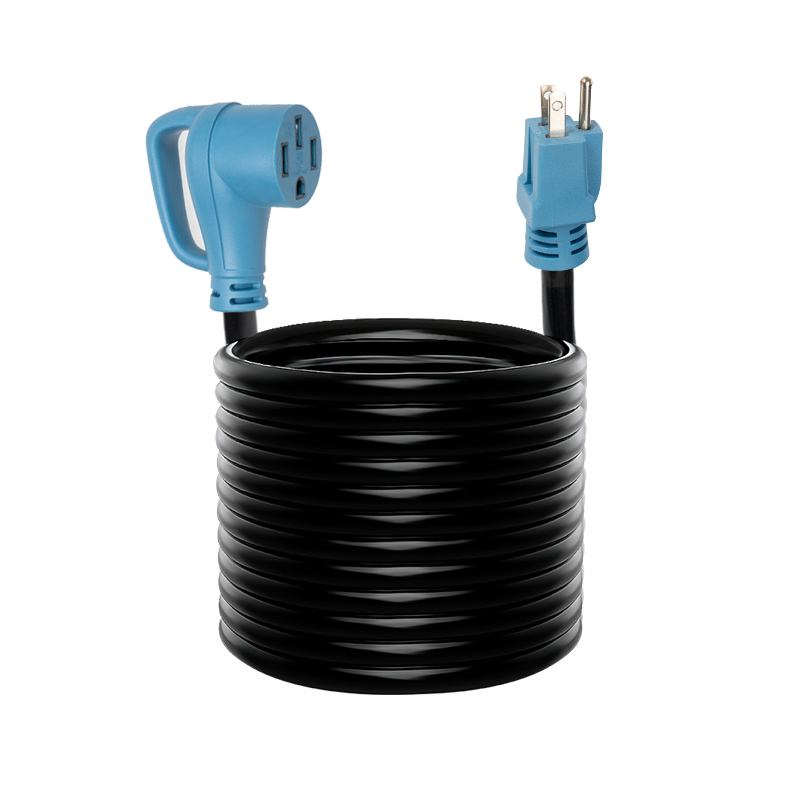
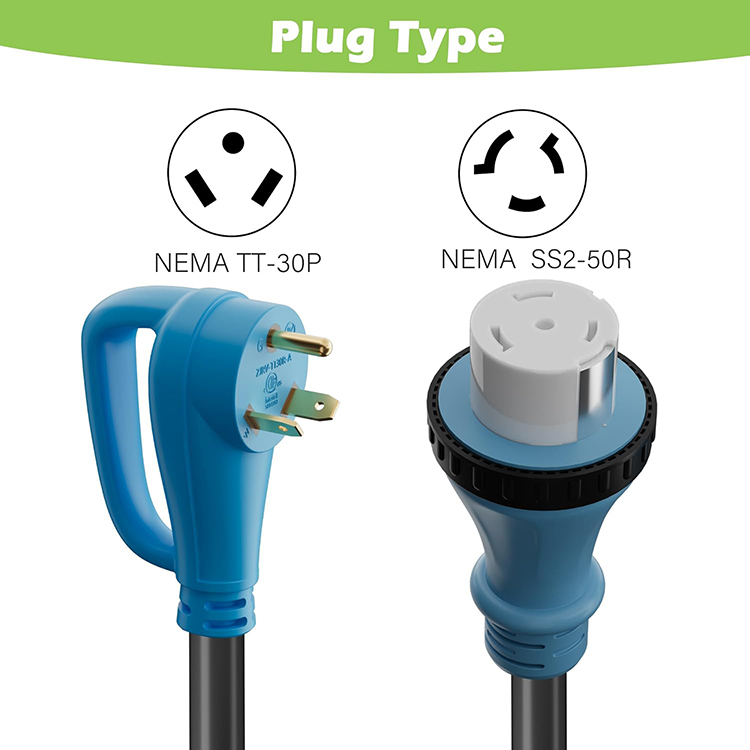 30 Amp to 50 Amp RV Adapter Cord, TT-30P to SS2-50R Twist LockThis step-up adapter lets a 50A RV draw from common 30A outlets, supporting low-wattage appliances and battery charge maintenance.View Product →
Specifications That Decide Whether the Cord Passes
A one-page spec sheet prevents most disputes. It should fix six items: the exact NEMA plug and receptacle designations, conductor gauge and strand count, overall length measured end to end, jacket compound and temperature rating, the marking on body and packaging, and the certification the finished assembly must carry.
| Adaptor family | Plug / receptacle | Conductor | Rating | Common defect |
|---|---|---|---|---|
| 50 A to 30 A dogbone | 14-50P to TT-30R | 10 AWG, 3-conductor | 50 A in / 30 A out | 12 AWG on the 50 A leg; body softened by heat |
| 30 A RV extension | TT-30P to L5-30R | 10 AWG, 3-conductor | 30 A, 125 V | Molded ends that lose retention after repeated mating |
| Household to RV | 5-15P to SS2-50R | 10 AWG, 3-conductor | 15 A, 125 V | Missing listing for the receptacle half |
| Generator to RV | L14-30P to TT-30R | 10/4 | 30 A, 240 V in | Wrong neutral bonding; ground continuity unchecked |
| Distribution | 14-50P to 4 x 5-15R/5-20R | 10 AWG | 50 A in, split loads | Branch loads not derated or fused |
Gauge is where quotes diverge, because copper is the largest single cost in the bill of materials. Twelve AWG in place of ten can move a landed price noticeably and still pass a visual check. Length works the same way: a 12 inch adaptor measured to the molded body is not the same product as one measured end to end, and two quotes compared side by side are often two different lengths.
Blade control is the second half of the job. Blade thickness and spacing are held to NEMA WD-6 dimensions, and the difference between a plug that seats firmly in a campground pedestal and one that falls out after a season is usually a few thousandths of an inch plus the retention spring inside the receptacle half. Pull strength at the strain relief is the third check — a cord that survives a pull test at the molding will not pull free of the body in service.
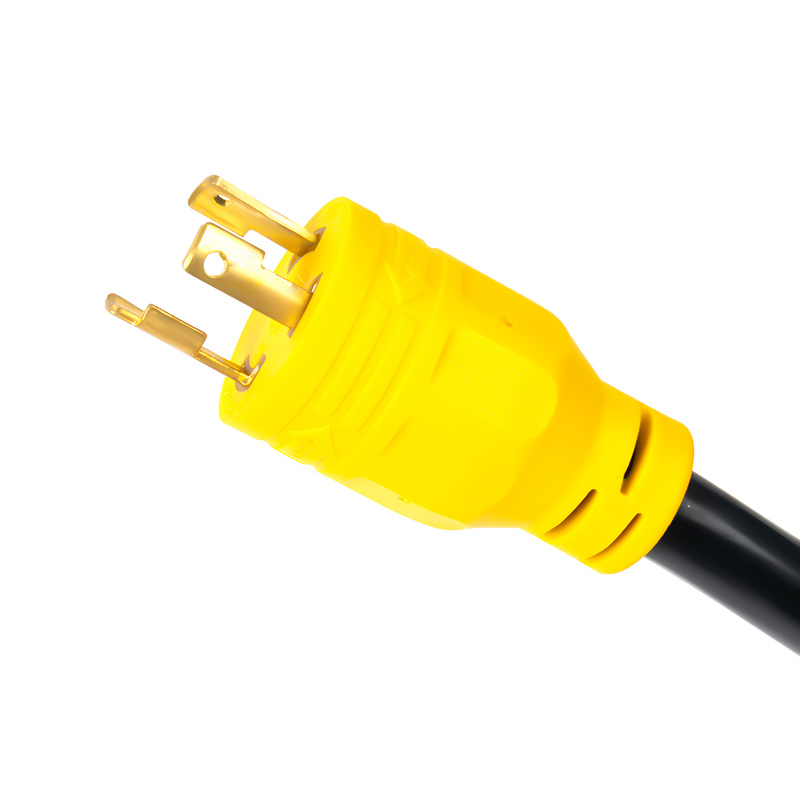
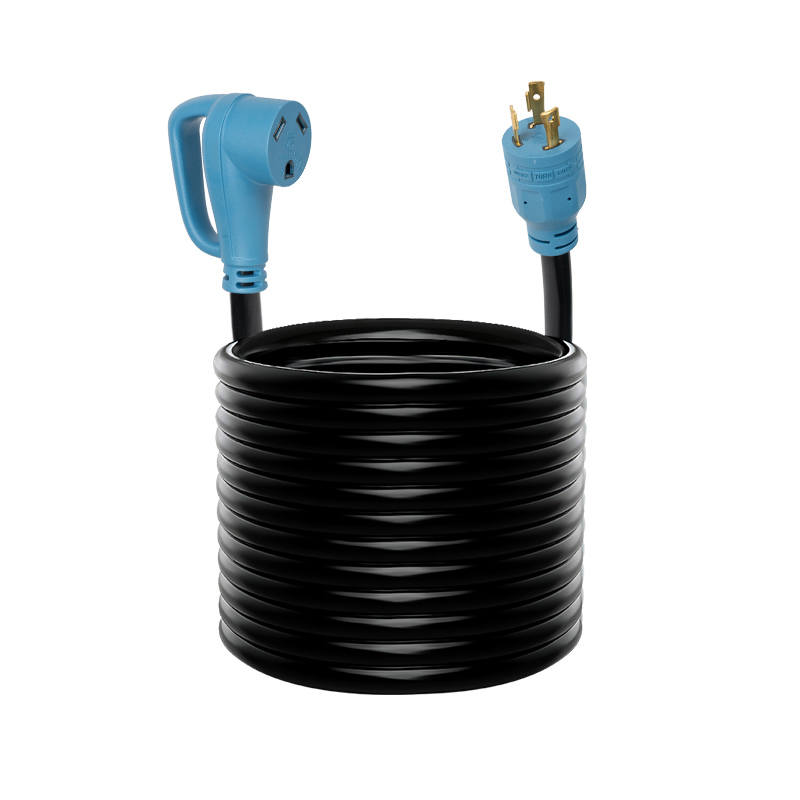
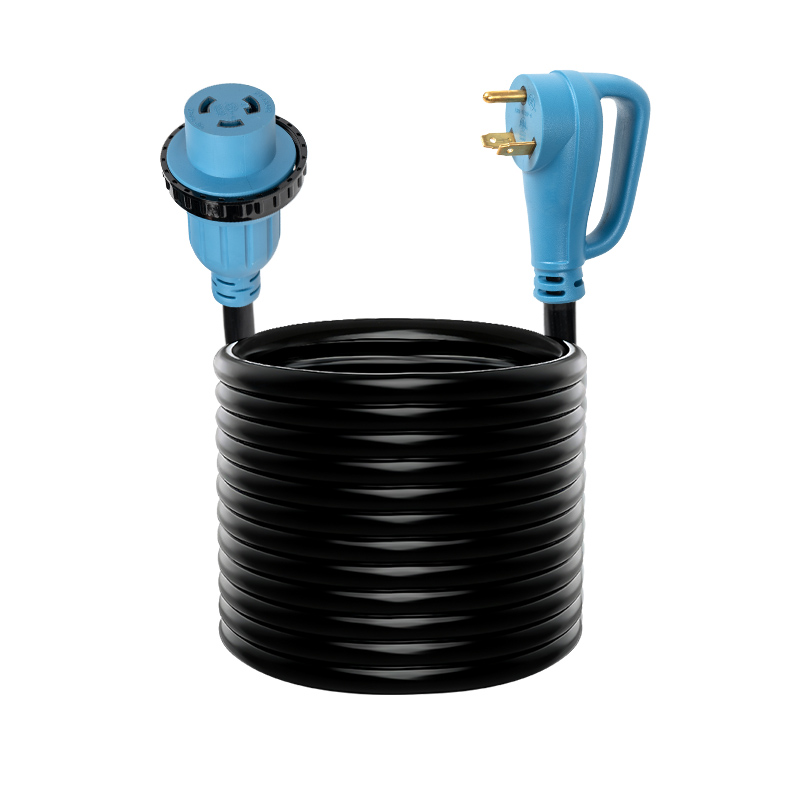
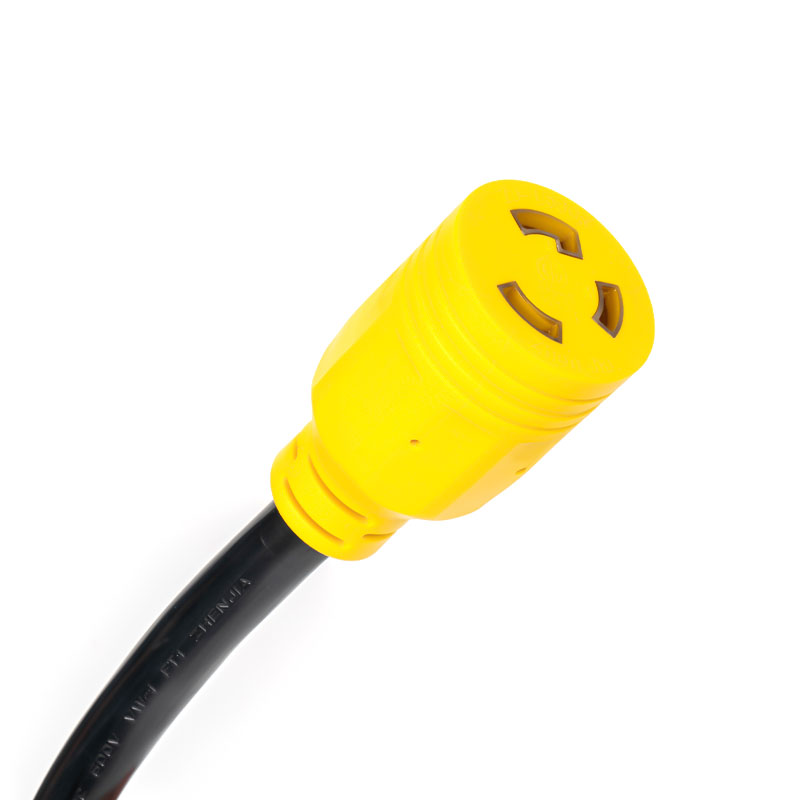 30 Amp RV Extension Cord with TT-30P to L5-30R Locking ConnectorETL/cETL-listed 125V 30A extension for travel trailers and campers with TT-30P plug, locking L5-30R connector, side wings, and weatherproof cover.View Product →
For a closer look at how these assemblies are put together, our RV extension cord build notes cover the crimp, molding and test sequence used for 30 A cord sets.
Load Planning: Gauge, Splitting and Real Current
Ampacity, not the label, sets what an adaptor can carry. The chart below shows 60 °C ampacity values commonly applied to flexible cord copper — the reason 30 A adaptor families are built on 10 AWG.
Ampacity by conductor size at 60 °C, indexed to the largest value in the chart.
This is why a 30 A adaptor with 12 AWG conductors is a design error rather than a cost saving. Under continuous load the copper heats, the jacket softens, and failure appears at the point of highest resistance — usually the crimp or the blade contact surface, not the middle of the cord.
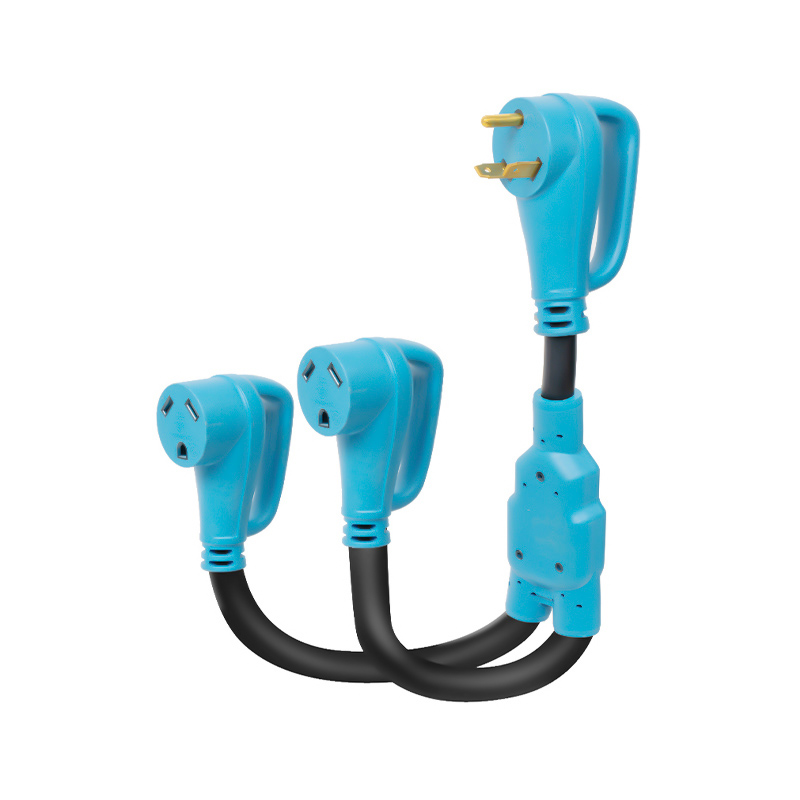
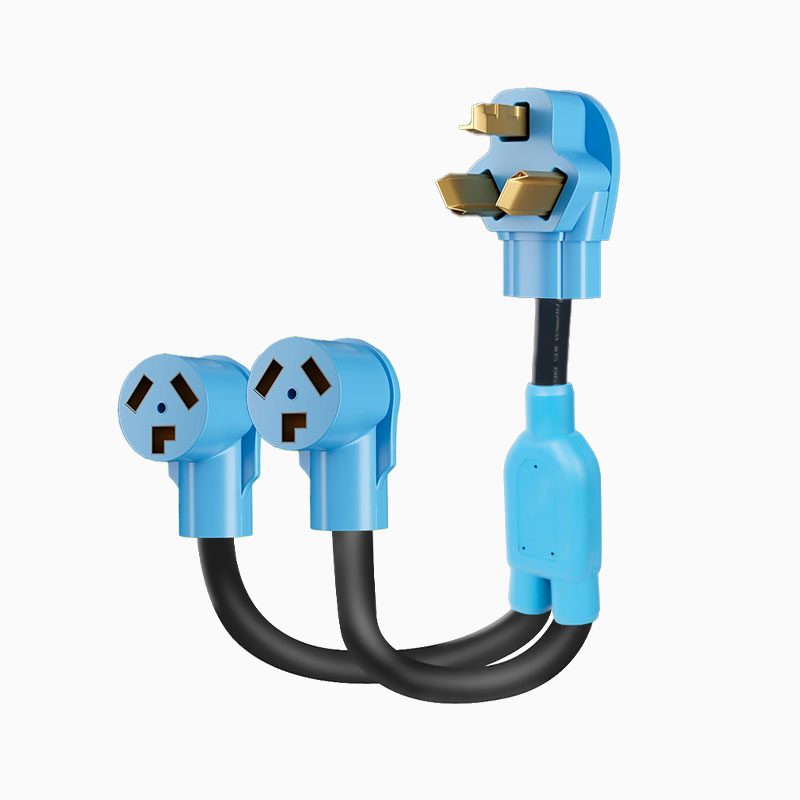
Distribution cords follow the same logic in the other direction. A 14-50P to four 5-15R/5-20R cord takes one 50 A outlet and splits it into household receptacles; a 30 A Y splitter lets two loads share one pedestal leg. The factory's job is to rate the assembly honestly, fuse branches where the design calls for it, and print the maximum combined current on the body.
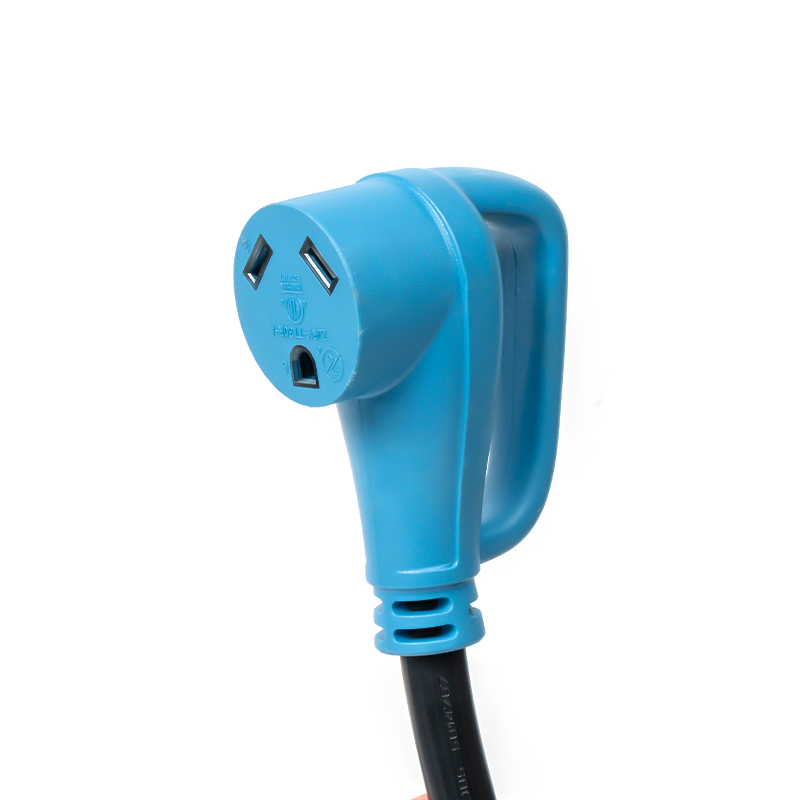 30 Amp RV Y Splitter Adapter Cord, TT-30P to Dual TT-30RSplits one TT-30P 30A outlet into two TT-30R receptacles for RV/EV power, with 10-gauge wire, 3750W rating, ETL listing, weatherproof flame-retardant UV-resistant construction.View Product →
The safe baseline when specifying: ground continuity and polarity verified on every unit, and a dielectric withstand test on every lot.
Certification: The Paperwork Has to Match the Product
In North America an RV adaptor cord set sells under a listing mark — c(UL)us or ETL — issued against a specific construction. File numbers matter more than logos. A certificate covering a 16 AWG indoor cord does not cover a 10 AWG, 30 A outdoor assembly, and a change of jacket compound, gauge or receptacle supplier can require re-evaluation.
When you request documentation, ask for three items:
- The listing file number and the exact catalog models it covers
- Recent factory test reports for temperature rise, dielectric withstand and continuity
- A written description of the construction the listing was granted for: gauge, length range, jacket material and plug configurations
For Europe the equivalent is CE marking supported by the relevant low-voltage and EMC documentation. Certification works best when a factory holds c(UL)us, ETL and CE across several product lines and runs an ISO 9001 quality system, because that combination usually comes with a written change-notification process — the mechanism that keeps a certificate valid after a component supplier moves.
Five Procurement Risks That Appear After Delivery
Most complaints on RV adaptor orders fall into five categories, and all of them are visible at the quotation stage.
- Gauge substitution. The sample was 10 AWG; production is 12 AWG with thicker insulation to keep the outer diameter unchanged. Require a conductor cross-section measurement in the inspection report.
- Listing scope mismatch. The mark is genuine but covers a different construction than the one shipped. Cross-check the file against the model on the label.
- Retention and fit. Blades out of tolerance, or a receptacle half that grips loosely. A mating-force check on a sample of twenty units catches it.
- Overstated ratings. A 30 A assembly printed "50 A" because the plug is a 14-50P. The connector standard does not upgrade the cord.
- Packaging claims. Retail headers promising weather resistance, compatibility or certifications the product does not have. These return as marketplace suspensions and dealer chargebacks.
One clause handles all five: no change of conductor, plug or jacket supplier without written approval and a new sample. Factories already selling into regulated North American channels treat that as normal practice; suppliers who resist it are telling you something useful.
Vetting a Factory Before the First Purchase Order
- Send a complete spec sheet — plug configurations, gauge, length, jacket, marking, packaging, target certification — and ask for a written quotation against it, not against a catalog photo.
- Request test reports tied to that exact part number, plus the listing file number.
- Order pre-production samples and test them: temperature rise at rated current, continuity, polarity, mating force and strain-relief pull.
- Audit the two processes that decide quality — copper crimping and injection molding. Ask how crimp height is monitored, how often molds are cleaned, and how finished goods trace back to a production shift.
- Agree on repeat-order verification: a retained golden sample, an incoming inspection standard, and a written change-notification rule.
A supplier with an in-house engineering team, an ISO 9001 system and its own manufacturing base — rather than only a trading office — answers these questions from records instead of memory. It also helps to know where the second production site is: capacity in more than one location keeps shipments moving when a line is fully booked or a tariff situation changes.
Start with the part, not the price. Define the plug configuration, conductor gauge, length and certification on one page, ask several factories to quote against that page, and test the samples at rated current before committing to tooling. The adaptors that survive a season of campground use are the ones whose copper, blades and paperwork matched the specification from the beginning — and the factory that can prove it on paper is the one worth keeping on your supplier list.
- [email protected]
- +(86)-0574-62162605
- +(86)-137 0584 5290
- No. 5-2, Yaobei Avenue, Simen Town, Yuyao City, Ningbo, Zhejiang Province, China
Copyright © NINGBO ZHENJIA ELECTRIC APPLIANCES CO.,LTD. All Rights Reserved. Custom Temporary String Light Manufacturers
