 English
 Español

Electric Range Cord Suppliers

Core Products & Expertise: EV Charging Solutions: J1772 Type 1 & Type 2 connectors, GB/T AC/DC charging cables, Electric Vehicle (EV) AC/DC charging connectors ("guns"),
and EV chargers.
Power Cords & Adapters: c(Ul)us-certified power cords, RV adapters, and various plugs/sockets.
Lighting Components: Temporary string lights and string light sockets/wiring.
Commitment to Excellence:
Professional R&D: Backed by a dedicated in-house R&D team driving innovation.
Robust Quality Assurance: Certified under ISO 9001 Quality Management System. Products hold key safety certifications, including c(Ul)us, ETL, and CE.
Advanced Manufacturing: Equipped with modern production facilities and stringent quality control processes.
Global Reach & Reputation:
Over the past decade, Zhenjia has achieved steady growth and earned recognition as a reputable enterprise within the industry. Our products are exported worldwide, with a
strong presence in demanding markets such as the United States.
Our Mission:
As China 3 Prong Range Cord Manufacturers and 4 Prong Range Cord Suppliers, we are committed to providing our global customers with reliable, safe, and high-performance products, supported by exceptional service. We strive to build lasting partnerships through continuous innovation and unwavering dedication to quality.
Looking Ahead:
Zhenjia Electric remains focused on advancing technology, enhancing manufacturing capabilities, and expanding our global footprint to meet the evolving needs of the market.
Certificate
-
 Certificate Of Compliance E529560
-
 Certificate Of Compliance E325763
-
 Certificate Of Compliance E321611
-
 Verification Of Compliance
-
 Verification Of Compliance
-
 Authorization To Mark
Factory
-
 Factory Equipment
-
 Factory Equipment
-
 Factory Equipment
-
 Factory Equipment
-
 Warehouse
-
 Warehouse
-
 Warehouse
-
 Work Shop
-
Imagine receiving a pallet of 500 LED work lights for a new logistics center, only to find that the daisy-chain connectors are rated for dry locations, the lead-in cords cannot reach the overhead busway, and the plugs are built for a 230V European system whil...
 VIEW MORE
2026.10.22
-
A container of 300 festoon sets arrives in Ohio, and every third unit fails the pull test on its molded plug. The lamps are fine. The sockets are fine. The conductor inside the plug is a thin strand that was never meant to carry the load across a 24-foot run,... VIEW MORE
2026.10.15
-
A distributor sends an RFQ for 5,000 RV adaptor cords: NEMA TT-30P male to 5-15R female, 12 inches, 10 AWG, retail bag. Three factories in Ningbo quote within eight percent of one another, and the samples look identical — same body, same color, same print. Th... VIEW MORE
2026.10.08
Contact Us
Range Cord
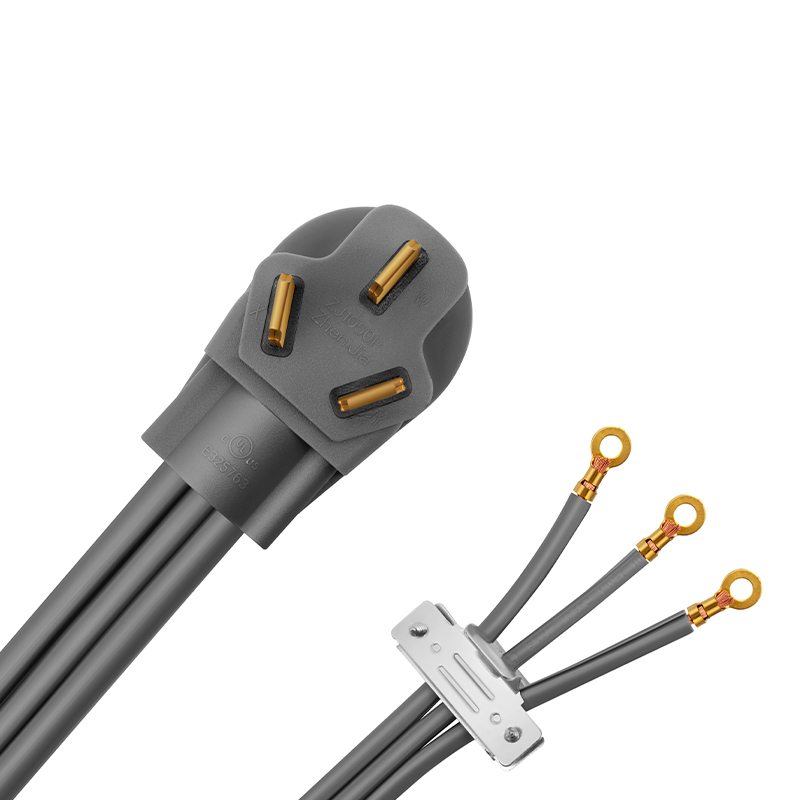
Ningbo Zhenjia Electric Appliances Co., Ltd. manufactures Range Cord assemblies for electric ranges, ovens and similar 240 V household appliances. Our range covers 3-prong and 4-prong 50-amp cords with eyelet connectors, built on c(UL)us-certified power cord construction and supplied to appliance OEMs, distributors and project buyers worldwide.
What We Manufacture in This Category
We build range cords as complete, ready-to-install assemblies: molded or assembled plug, flexible copper conductor, ring-terminal eyelets and a strain-relief transition sized to the appliance chassis. The two catalogue models are the 50-amp 3-wire range cord and the 50-amp 4-wire range cord, both using copper conductors and eyelet connectors for direct connection to the range terminal block.
Because we also produce the broader Power cord family, conductor stranding, insulation compounds and plug bodies come from the same controlled supply chain. That matters when a range cord has to match the colour code, jacket hardness and temperature behaviour of the rest of an appliance wiring set.
3-Prong and 4-Prong Range Cord Range
50-Amp 3-Prong Range Cord
Three wires with eyelet connectors, copper conductor. Suited to older 3-wire branch circuits and replacement service on existing installations.
- 3 conductors plus grounding path per circuit type
- Eyelet terminals for terminal-block screws
- Molded plug body with strain relief
50-Amp 4-Prong Range Cord
Four wires with eyelet connectors, copper conductor. Matches modern 4-wire range circuits where neutral and ground are separate.
- Separate neutral and equipment ground
- Colour-coded conductors for terminal identification
- Lengths and terminal hole sizes configured to order
Application Fit and Circuit Matching
Range cords sit between the wall receptacle and the appliance terminal block. Correct selection starts with the branch circuit: a 3-wire circuit needs a 3-prong cord, a 4-wire circuit needs a 4-prong cord, and the plug configuration must match the receptacle already installed in the kitchen. We confirm this against the appliance rating plate before quoting.
| Configuration | Circuit Type | Typical Appliance | Termination |
|---|---|---|---|
| 50 A, 3-prong | 3-wire, 240 V | Freestanding electric range | Eyelet connectors |
| 50 A, 4-prong | 4-wire, 240/120 V | Range, wall oven, cooktop | Eyelet connectors |
| Custom lengths | Per appliance design | OEM range platforms | Eyelet or configured terminal |
Materials and Critical Specifications
Copper conductors carry the load current; the insulation and jacket must tolerate the heat radiated from the back of a range. We confirm conductor gauge, insulation material, jacket material, temperature rating and plug body material against the appliance's electrical and thermal requirements.
- Conductor: stranded copper, sized to the 50 A rating and the required voltage drop over the cord length
- Insulation and jacket: selected for heat resistance and mechanical protection behind the appliance
- Plug and connector body: molded construction with integral strain relief
- Terminals: eyelet connectors with hole diameter and stud size matched to the range terminal block
- Markings: conductor identification and cord rating printed or moulded as required by the destination market
Configuration Options We Build To
Range cords are rarely one-size-fits-all. We configure the assembly around the appliance interface rather than forcing a catalogue item into a design that does not fit.
- 3-wire or 4-wire construction
- Cord length from short appliance tails to longer service lengths
- Eyelet hole diameter, ring orientation and stud size
- Conductor colour sequence to match the appliance wiring diagram
- Plug type matched to the receptacle standard of the destination market
- Private-label printing and packaging for distributor programmes
Where a project needs a different plug standard or a related appliance lead, our Dryer Cord range and the wider Range And Dryer Cord family use the same conductor and termination approach.
Quality Control and Compliance Evidence
Our production operates under an ISO 9001 quality management system, with in-house testing laboratory and inspection equipment used across the power cord lines. Range cords are built on c(UL)us-certified power cord construction, and our compliance documentation includes Certificate of Compliance E529560, E325763 and E321611, Verification of Compliance records and Authorization To Mark.
For appliance OEM and distributor programmes we can supply the certificate references that apply to the cord construction used, together with routine inspection records for the production batch. Acceptance criteria are agreed at the quotation stage so that incoming inspection at the customer's plant matches what we test in our own laboratory.
Installation, Maintenance and Serviceability
Range cords are installed by connecting the eyelets to the appliance terminal block, routing the cord through the strain-relief clamp and securing the plug into the wall receptacle. Correct torque on the terminal screws and a properly seated strain relief are the two points that determine long-term reliability.
- Terminal screws torqued to the appliance manufacturer's specification
- Strain relief clamped on the outer jacket, not on individual conductors
- Cord routed clear of the oven vent and sharp chassis edges
- Visual inspection of insulation and terminals at each service visit
We keep the plug body, terminal and conductor specifications on file so that replacement cords for an existing appliance platform remain consistent over repeat orders.
Information We Use to Configure Your Solution
To prepare an accurate range cord proposal we work from the appliance and the installation, not from a generic part number. The following inputs let us confirm construction, tooling and packaging in one pass.
| Input | Why We Need It |
|---|---|
| Appliance type and rating plate | Confirms current, voltage and 3-wire or 4-wire requirement |
| Receptacle standard and plug type | Matches the cord to the installed wall outlet |
| Cord length and routing | Sets conductor length and strain-relief position |
| Terminal block drawing | Defines eyelet hole size, stud size and ring orientation |
| Destination market and certification need | Selects the applicable cord construction and marking |
| Packaging and label requirements | Prepares retail or bulk packaging for the distribution channel |
Drawings or physical samples are both workable. Our R&D team develops and produces to customer drawings or samples, and we can review an existing cord to confirm whether a direct replacement or a modified construction is the better route.
Frequently Asked Questions
What is the difference between a 3-prong and a 4-prong range cord?
A 3-prong range cord connects to a 3-wire branch circuit, where the neutral also serves as the grounding path. A 4-prong range cord connects to a 4-wire circuit with separate neutral and equipment ground conductors. The correct choice is determined by the receptacle and circuit already installed, not by the appliance alone.
Can you supply range cords with custom lengths and eyelet sizes?
Yes. We configure cord length, conductor colour sequence, eyelet hole diameter, ring orientation and stud size to the appliance terminal block drawing. Custom lengths are common for OEM range platforms where the standard catalogue length does not reach the terminal block cleanly.
What certifications apply to your range cords?
Our range cords are built on c(UL)us-certified power cord construction, and our compliance file includes Certificate of Compliance E529560, E325763 and E321611, Verification of Compliance records and Authorization To Mark. We confirm which certificate applies to the specific cord construction quoted for your project.
Do you produce range cords for private-label distribution?
We produce private-label range cords for distributor programmes, including printed markings and retail or bulk packaging. Packaging artwork, label content and carton configuration are agreed before production so that the delivered goods match the sales channel.
How do you handle repeat orders for an existing appliance platform?
We keep the approved conductor, plug body, terminal and packaging specifications on file. Repeat orders are produced against those records, which keeps replacement cords consistent with the original appliance build and simplifies incoming inspection at your plant.
- [email protected]
- +(86)-0574-62162605
- +(86)-137 0584 5290
- No. 5-2, Yaobei Avenue, Simen Town, Yuyao City, Ningbo, Zhejiang Province, China
Copyright © NINGBO ZHENJIA ELECTRIC APPLIANCES CO.,LTD. All Rights Reserved. Custom Electric Range Cord Suppliers
