 English
 Español

LED String Light Manufacturer: How to Vet Certified Outdoor Sets for Buyers
Content
- 1 What the Manufacturer Actually Controls
- 2 Anatomy of a String Light: Where the Risk Sits
- 3 The Five String Light Families Buyers Actually Specify
- 4 Wire Gauge and Run Length: The Chart That Prevents Melted Jackets
- 5 Waterproof Connectors Decide Outdoor Service Life
- 6 Interconnect Parts: Lamp Cord, Link Cables and Switches
- 7 Construction and Jobsite String Lights
- 8 Order Questions That Expose a Weak Supplier
- 9 Lead Time, MOQ and Production Reality
A container of 300 festoon sets arrives in Ohio, and every third unit fails the pull test on its molded plug. The lamps are fine. The sockets are fine. The conductor inside the plug is a thin strand that was never meant to carry the load across a 24-foot run, and the crimp was closed by hand.
That single defect explains most of what separates a real LED string light manufacturer from an assembly shop. The factory worth buying from is, at its core, a cord and connector maker that also mounts lamps, not a bulb seller that buys loose plugs by the box. Buyers who grade suppliers on lumen output alone tend to see returns during the first wet season. Buyers who grade on plug construction, conductor size, waterproof interfaces and certification files usually get sets that survive several outdoor seasons without a service call.
What the Manufacturer Actually Controls
Vertical range matters more than catalogue length. A supplier that strands its own copper, molds its own plugs and sockets, and controls its own crimping can hold tolerances across production lots. One that buys plugs from a second factory and cords from a third has no way to prove that the plug molded in March matches the plug molded in September.
Ningbo Zhenjia Electric works along that vertical line: in-house research and development, ISO 9001 quality management, production in Ningbo plus a self-owned overseas plant, and a range that runs from 18 AWG replacement power cords through waterproof 2-pin and 3-pin extension cables to E26 lamp cord kits and LED string lights. Its c(UL)us and ETL listings cover the US and Canada, and CE covers Europe, which is what makes one platform sellable in both retail and project channels.
Anatomy of a String Light: Where the Risk Sits
Strip a festoon set down to its parts and the failure points map almost one-to-one onto the components.
- Mains interface
- NEMA 5-15P, BS1363 Type G, Schuko CEE 7/7, Brazil three-pin
- Fused right-angle plugs, inline switches, waterproof plug bodies
- Conductors and jacket
- 18 AWG to 10 AWG stranded copper, plus 10/4 builds for heavier runs
- PVC, rubber or braided textile jackets in single and two-color finishes
- Joints and interfaces
- Molded or gasketed sockets, 2-pin and 3-pin waterproof inline connectors
- Double-male T5/T8 link cables for linear LED lighting
- Lamp end: E26/E27 screw base, C7/C9 base, or an integrated LED module
- End hardware: terminator cap, end connector, hanging hardware
- Controls: dimmer, photocell, remote receiver
Every branch of that tree is a place where a low-cost supplier shaves money. Conductor size drops two steps, gasket thickness halves, plating on the socket contacts disappears, and the end cap becomes a strip of tape. None of those changes shows up in a photograph of a lit string. All of them show up in a returns report.
The Five String Light Families Buyers Actually Specify
Specification starts with the family, because each type is defined by its connector and its environment rather than by its bulb.
| Family | Typical voltage | Defining connector | Conductor | Outdoor rating | Common failure mode |
|---|---|---|---|---|---|
| Decorative festoon with E26/E27 sockets | 120 V or 230 V | Molded plug, screw base | 18 to 16 AWG | IP44 to IP65 | Water tracking into the socket gasket |
| Low-voltage deck and landscape | 12 V or 24 V DC | 2-pin waterproof inline | 18 to 14 AWG | IP65 to IP68 | Pin corrosion, reversed polarity |
| Commercial permanent install | 120 V | C7/C9 or E26 string | 16 to 14 AWG | IP65 with UV-stable jacket | Jacket cracking after two summers |
| Linear LED tube link (T5/T8) | 120 to 277 V | Double-male link cable | 18 AWG | Indoor | Loose pin contact at the joint |
| Jobsite and construction | 120 V | Molded plug and receptacle | 14 to 12 AWG | IP44 inside a cage | Impact damage and cord abrasion |
Read the table from right to left. The failure mode tells you which line on the purchase order to tighten: gasket material for the festoon family, pin plating and polarity keying for low-voltage runs, UV stabilizer for permanent installs, contact retention for tube links, and jacket abrasion resistance for jobsite sets.
Wire Gauge and Run Length: The Chart That Prevents Melted Jackets
Conductor size is the first number to fix, and it is the number most often left blank on a quotation. These are typical ampacities for flexible cord stock; the rating that applies to your assembly is the one printed in the listing file for that specific cord type.
A 40 W decorative set drawing 0.33 A at 120 V is comfortable on 18 AWG. Chain four of those sets and the run carries roughly 1.4 A, still inside the rating, but voltage drop starts to show as dim lamps at the far end. On a 24 V DC deck run, length is where gauge stops being optional: at low voltage the same watts pull far more current, and a 50-foot run on 18 AWG can lose enough voltage to make the last fixtures visibly darker than the first.
Waterproof Connectors Decide Outdoor Service Life
Where Water Actually Gets In
Almost no outdoor string light fails because water touches the outside of a connector. It fails because water reaches the metal. The two entry paths are the cable-to-housing interface and the mating face, which is why a gasket that holds compression across the full temperature range matters more than the wall thickness of the shell.
Molded Is Not Automatically Better
An overmolded joint seals the cable entry permanently and resists flexing, which suits short decorative sets. A field-assembled, gasketed connector can be opened and re-terminated, which suits deck and landscape runs where a single damaged fixture should not force the replacement of an entire 50-foot line. The right answer depends on whether the installation expects maintenance or replacement.
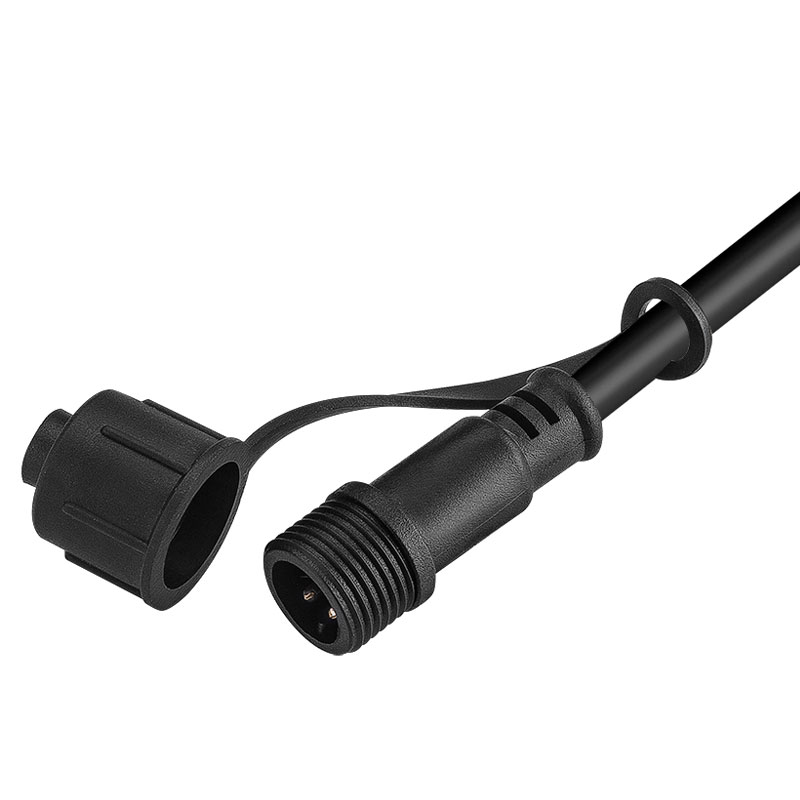 Waterproof 2-Pin Extension Cable for LED Deck LightingWeather-resistant 2-pin extension cable for LED deck lights, available in 18, 16, and 14 AWG and multiple lengths. Suited to maintenance-friendly deck and step lighting.View Product →
Deck and step lighting is a good example of the maintenance case. An 18 AWG 2-core waterproof extension cable built for LED deck lights lets a fixture be added or replaced without discarding the run, and the same platform scales to a 10-foot 2-core version available in 14 or 16 AWG for longer spans and to a 14 AWG 3-core build when a third conductor is required.
Interconnect Parts: Lamp Cord, Link Cables and Switches
String light buyers rarely order a single part number. A typical shipment mixes mains leads, link cables and control hardware, and the interconnect parts are where compatibility problems surface after the container has shipped.
For pendant and retrofit lighting, an E26 lamp cord kit with a hanging socket allows a fixture to be assembled on site from a standard bulb. For linear LED lighting, a double-male T5/T8 connector cable joins two tubes end to end on a single circuit, while a version with an integrated on/off switch puts control at the fixture instead of at the wall, which is what maintenance crews actually want in a ceiling grid.
 Double Male-Ended T5/T8 LED Tube Connector CableConnector cable joins T5/T8 LED tubes end to end on a single circuit. Rated 10A, 250V, with 18/3 SVT wiring for linear and retrofit lighting.View Product →
The specification points to confirm here are pin diameter and spacing, contact retention force, and the current rating of the link joint. A link cable rated at 3 A used between two 25 W tubes is not a problem; the same cable on a longer run of higher-output tubes is.
Construction and Jobsite String Lights
Jobsite lighting has a different brief from decorative lighting: it needs to be visible, durable and quick to hang on temporary structures. A practical jobsite family ranges from a 10 W construction string light for general task visibility up to a 15 W version for longer runs, plus a work light with an integrated switch and receptacle so a power tool can be plugged into the same drop.
Because these sets are handled roughly, hung on rebar and moved between floors, the plug body, strain relief and jacket abrasion resistance carry more weight in the buying decision than the lamp itself. Buyers evaluating this category can review how string lighting is specified for construction work in this guide to construction string lights.
 Contractor-Grade LED Construction String Light SetContractor-grade 50 ft LED string light set with five 15W lamps. Built for rough handling on construction sites with IP65 and IK08 ratings.View Product →
Order Questions That Expose a Weak Supplier
These eight questions separate a factory that owns its process from one that assembles whatever arrives on the dock.
- What conductor size and strand count are used, and at which step is the crimp closed and verified?
- Which listing covers the finished assembly, c(UL)us, ETL or CE, and can you send the file numbers rather than a logo?
- What is the gasket material at each outdoor joint, and how much compression does it hold after thermal cycling?
- What is the measured voltage drop at rated load across the longest standard length?
- Which plug standard is molded for the destination market, and can one line supply NEMA, BS1363, Schuko and Brazil versions?
- What is the pull-test value on the plug-to-cord joint, and how is it sampled per lot?
- What happens when a lot deviates: retest, rework, or replacement, and who pays the freight?
- Can the same tooling and the same copper source be locked for repeat orders?
Lead Time, MOQ and Production Reality
Lead time on string lights is usually driven by molding tooling and by the availability of the specific plug standard, not by lamp supply. A supplier running its own injection shop in Ningbo alongside an overseas plant can split a programme between locations, which shortens the response on repeat orders and reduces exposure when one site is congested. Minimum order quantities then track the tooling: a standard NEMA or BS1363 plug body can ship in modest volumes, while a new overmold shape needs a volume commitment that covers the tool.
The practical consequence for a buyer is to standardize on plug bodies, conductor sizes and socket geometry that the factory already runs, and to spend the customization budget on the parts customers actually see and touch.
An LED string light manufacturer is judged less on the lamp and more on the cord, the plug and the joint between them. Conductor size, gasket compression, contact plating and the listing file are the four items that decide whether a set comes back from a customer or stays in service through a second winter.
Fix those four on the purchase order, and the brightness conversation becomes a marketing decision rather than a warranty risk.




- [email protected]
- +(86)-0574-62162605
- +(86)-137 0584 5290
- No. 5-2, Yaobei Avenue, Simen Town, Yuyao City, Ningbo, Zhejiang Province, China
Copyright © NINGBO ZHENJIA ELECTRIC APPLIANCES CO.,LTD. All Rights Reserved. Custom Temporary String Light Manufacturers
