 English
 Español

Range and Dryer Cord Supplier: How to Match Plugs, Gauge, and Certification
Content
Picture a maintenance tech at a 40-unit apartment complex holding a new four-prong dryer cord and facing a three-slot wall receptacle. The dryer nameplate says 30 A. The breaker says 30 A. The cord in the box is 10/4 with a NEMA 14-30P plug. Nothing in that stack is defective, and the installation still cannot proceed.
That is why the specification, not the price, decides who you buy from. The short version: the cord must match the receptacle on one end, the appliance terminal block and nameplate on the other, and the branch circuit behind both. A range and dryer cord supplier earns its place by stocking both NEMA families, printing gauge and length on the cord tag accurately, and being able to show a certification file for the exact configuration you ordered.
Match the receptacle before the appliance
North American dryer and range cords split into two families, and each family maps to a specific receptacle. Three-wire cords, NEMA 10-30 for dryers and NEMA 10-50 for ranges, carry two hots and a neutral, and in legacy installations the appliance frame is bonded to that neutral. Four-wire cords, NEMA 14-30 and 14-50, add a separate equipment ground. Since the 1996 NEC cycle, new branch circuits for electric ranges and dryers in the U.S. have been required to be four-wire, which is why both generations of receptacle are still in service side by side.
The plug shape encodes the circuit rating, so a cord that physically fits is not automatically the right one. Count the slots at the wall, read the nameplate, and only then pick the SKU.
| Cord family | Plug and receptacle | Circuit | Conductors | Where it fits |
|---|---|---|---|---|
| Dryer, 3-wire | NEMA 10-30P to 10-30R | 30 A, 125/250 V | 2 hots plus neutral, 10/3 | Legacy three-slot installations |
| Dryer, 4-wire | NEMA 14-30P to 14-30R | 30 A, 125/250 V | 2 hots, neutral and ground, 10/4 | Four-slot outlets and new branch circuits |
| Range, 3-wire | NEMA 10-50P to 10-50R | 40-50 A, 125/250 V | 2 hots plus neutral, 6/3 | Older three-slot range outlets |
| Range, 4-wire | NEMA 14-50P to 14-50R | 40-50 A, 125/250 V | 2 hots, neutral and ground, 6/4 | Four-slot outlets, most current construction |
The two dryer families are the ones buyers misorder most often, because both are 30 A and both look plausible in a catalog photo. Keeping one of each in stock turns a retrofit emergency into a routine visit.
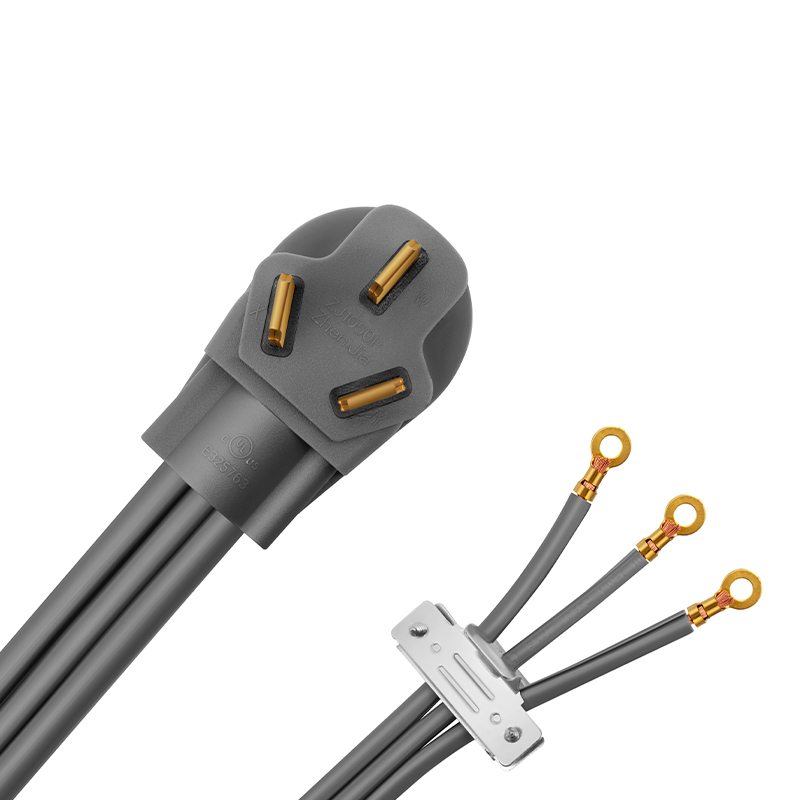
 30 A 3-Prong Dryer Cord with NEMA 10-30PA 30 A, 3-prong dryer cord with NEMA 10-30P, eyelet connectors and 10-gauge copper, useful for matching the common 30 A dryer circuit.View Product →
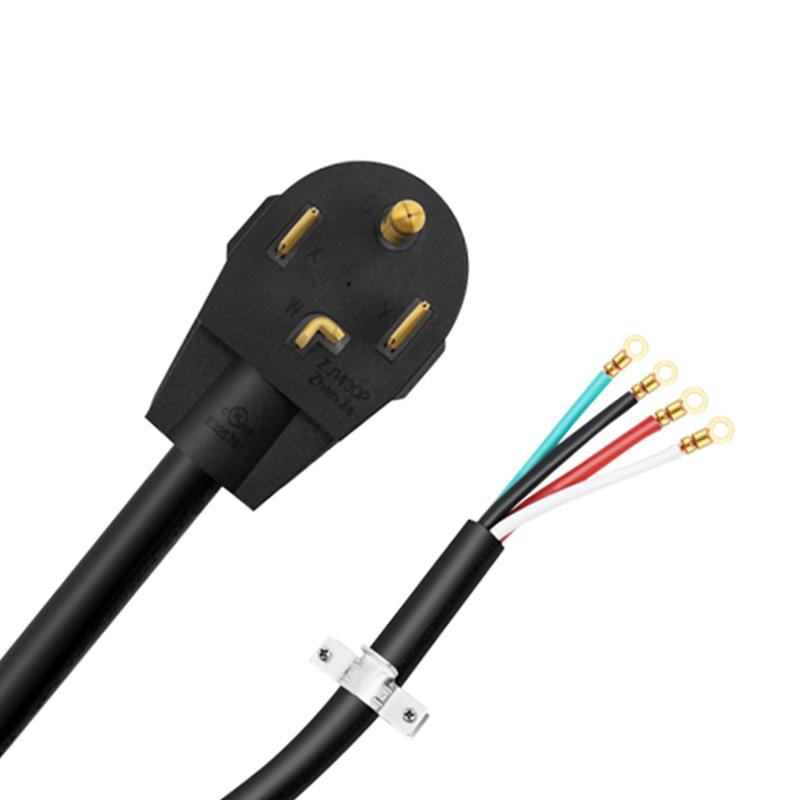
 30 A 4-Prong Dryer Cord, NEMA 14-30P, 10/4 GaugeA 30 A, 4-prong dryer cord with 10/4 copper, ring terminals and a right-angle NEMA 14-30P plug, suited to standard four-wire dryer outlets.View Product →
Gauge, length, and termination: where low-cost cords fail
A 30 A dryer circuit typically pairs with 10 AWG copper, a 40 A range circuit with 8 AWG, and a 50 A range circuit with 6 AWG. The cord must be rated at least to the branch circuit, not to the appliance's marketing wattage. A dryer drawing 5,600 W and one drawing 7,200 W ride on the same 30 A circuit and the same 10/4 cord.
Length is often over-thought and sometimes under-thought. A six-foot 10 AWG cord adds roughly 0.3 V of drop at 24 A, which is irrelevant to performance; what matters is that the cord is not used as an extension and does not sit coiled behind the appliance where heat cannot escape. Order the shortest length that reaches the receptacle with a little slack, usually 4 to 6 ft for dryers and 4 to 5 ft for ranges.
Terminations are where cheap cords announce themselves. Look for closed-eye ring terminals sized for the appliance's terminal studs, captive washers or a locking tab, insulation rated 75°C or 90°C, and a strain-relief clamp that grips the jacket rather than the conductors. A cord that ships without a knockout clamp forces the installer to improvise, and improvised strain relief is exactly what a third-party inspector writes up.
Read the certification file, not the label
In North America, a range or dryer cord set is a listed product, and that listing is what a buyer should be able to verify. A c(UL)us mark means the cord was evaluated to the UL 817 cord-set standard for both the U.S. and Canada; an ETL mark is an equivalent NRTL listing accepted in the U.S. market; CE is a European self-declaration of conformity rather than a third-party listing, so treat it as a different class of evidence. An ISO 9001 certificate speaks to process control at the factory and says nothing about whether a particular plug body passed a temperature-rise test.
Three practical checks catch most problems before a container ships:
- The certificate scope names cord sets and power-supply cords, and the file number can be looked up in the listing body's public database.
- The cord tag on the sample matches the drawing: gauge, conductor count, length, temperature rating, and catalog number. Misprinted tags are a recurring issue in this category, and a 10/4 cord tagged 10/3 will stop an incoming inspection.
- The plug molding is uniform, with no flash or weld line across the blades, and the blades are solid brass or plated to the drawing rather than a soft alloy.
Ask for the certificate PDF, the test report summary, and a RoHS declaration in the same email thread. A supplier who answers that request in a day is a different kind of partner from one who forwards a photo of a carton.
The three-slot retrofit trap
When the receptacle and the appliance disagree, the temptation is to modify one of them. Cutting the ground pin off a four-wire cord, bonding neutral to ground inside the appliance, or swapping the receptacle without touching the circuit are all ways to create a shock hazard and an inspection failure. The compliant path is to change the cord to match the receptacle, or to have a licensed electrician bring the branch circuit to a four-wire configuration, and to document which was done.
The economics are simple even before safety enters it: a second truck roll and a returned appliance cost far more than the difference between a well-made cord and a cheap one.
Range cords and the 40 A question
Range installations add one wrinkle. Receptacles in this category, NEMA 10-50 and 14-50, are 50 A devices, and they appear on 40 A range circuits as well as 50 A ones. That is normal: the cord and receptacle are rated at least as high as the circuit, and the appliance nameplate current is lower than both. The cord, however, still has to be built for the circuit it serves, so a 40 A range does not get a lighter cord than a 50 A range on a 40 A circuit.
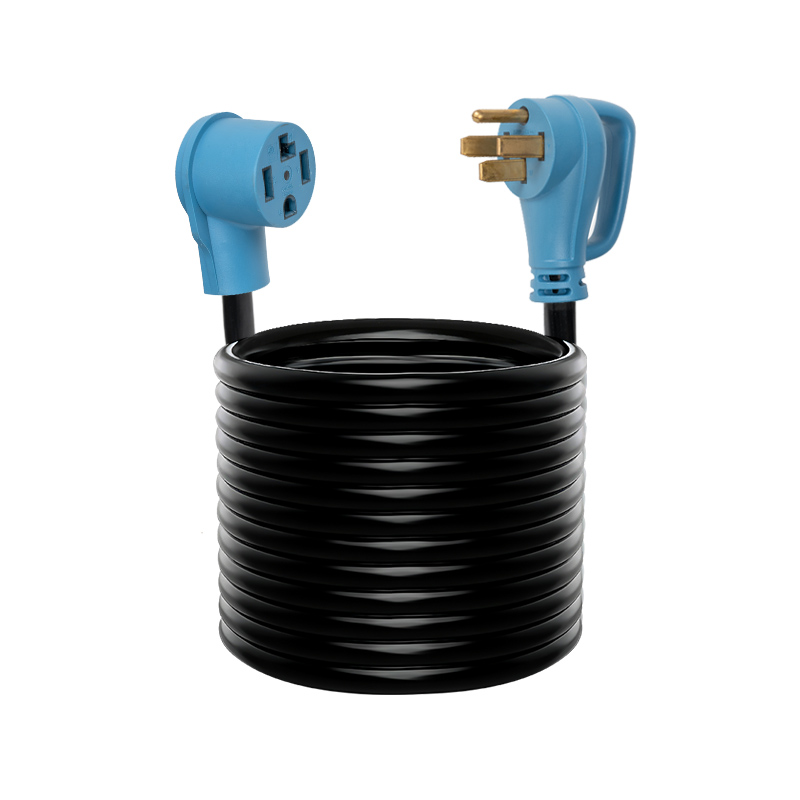
 50 A 4-Prong Range Cord with Ring TerminalsA 50 A, four-wire range cord with copper conductors, ring terminals and strain relief, for connecting a range to a compatible 50 A receptacle.View Product →
For the 50 A four-prong version, the conductor set is 6/4 with a separate ground; the three-prong variant is 6/3 and is only appropriate where the receptacle is a matching 10-50. Running a 6/3 cord to a 14-50 receptacle and leaving the ground terminal empty is a common field shortcut and a common inspection finding.
What belongs on the RFQ
Most quoting errors in this category come from incomplete requests, not from weak suppliers. An inquiry that answers the following gets a usable price and a correct sample on the first pass:
- NEMA designation for plug and connector, for example 10-30P to 10-30R or 14-50P to 14-50R
- Circuit rating and voltage, plus the appliance nameplate current
- Conductor count and gauge written as a fraction: 10/3, 10/4, 6/3, 6/4, with copper type and stranding
- Overall length, jacket material, and temperature rating
- Terminal style, stud size, and whether a strain-relief clamp is included
- Certification marks required and the destination market
- Cord tag content, packaging format, barcode, and carton marking
- Estimated annual volume and the mix of SKUs per order
Suppliers who mold their own plug bodies and assemble in-house can usually confirm dimensions from tooling drawings rather than guessing, which shortens sample approval. It is also worth asking how much of the line is produced in-house versus bought in, because that answer predicts how quickly a mixed order of dryer cords, range cords, and related adapters can be consolidated into one shipment.
Where the cord line fits a broader order
Range and dryer cords rarely ship alone. A distributor ordering appliance cords is usually stocking extension cords, RV adapters, and generator accessories too, and every additional manufacturer adds an incoming inspection, a container plan, and a certificate file to manage. Consolidating those lines reduces all three.
Ningbo Zhenjia Electric manufactures appliance cords alongside extension cords, EV charging cables, generator inlet boxes, and twist-lock devices, with c(UL)us, ETL, and CE listings plus ISO 9001 process control behind the range. The dryer and range power supply cord range covers three- and four-wire dryer cords and 50 A range cords in 10/3, 10/4, 6/3, and 6/4 configurations. Production spans a Ningbo plant and an overseas facility, which helps when one market needs stock while another is still in sample approval, and the cord catalog lets buyers match plug configurations across categories before committing to a container.
Start with the receptacle, size the conductors to the circuit, and require the certificate file before the purchase order. Those three steps remove almost every failure mode in this category, and they turn a commodity purchase into a line you can stock without callbacks.



- [email protected]
- +(86)-0574-62162605
- +(86)-137 0584 5290
- No. 5-2, Yaobei Avenue, Simen Town, Yuyao City, Ningbo, Zhejiang Province, China
Copyright © NINGBO ZHENJIA ELECTRIC APPLIANCES CO.,LTD. All Rights Reserved. Custom Temporary String Light Manufacturers
