 English
 Español

RV Adaptor Factory Guide: Plug Standards, Safety and Sourcing Checklist
Content
An RV park pedestal is a poor place to discover that a 30A adapter is wired for the wrong blade pattern. A buyer may approve a sample because it plugs in, only to find the 50A RV inlet is limited to 30A, the neutral is not where the electrician expected it, or the connector body cannot survive a wet, repeated connect/disconnect cycle. The practical conclusion: choose an RV adaptor factory by its ability to document plug standards, amperage limits, test evidence, and change control, not by the lowest per-unit quote.
The adapter itself is a short assembly, but it sits at a high-consequence junction: campground pedestal, generator feed, transfer switch, or household outlet on one side; RV inlet, EV charger, or distribution cord on the other. That makes the product a specification item first and a price item second.
Match the Pedestal, Not the Catalog Nickname
“30A to 50A” and “50A to 30A” are useful shorthand, but they do not define a safe assembly. The purchase order should name the male and female NEMA configurations, the voltage rating, the number of poles and wires, and whether the connection is locking or non-locking. A TT-30P to 14-50R adapter lets a 50A RV connect to a 30A pedestal, but it does not create 50A service; the RV still has to manage its load within the pedestal’s 30A limit. A 14-50P to TT-30R dogbone does the reverse: it connects a 30A RV to a 50A pedestal, and the RV remains a 30A load.
That distinction belongs in the product drawing and on the label. If the factory only describes the adapter by current rating, the buyer cannot confirm blade spacing, neutral position, grounding path, or compatibility with the intended inlet. The same issue appears in generator and transfer-switch adapters, where L5-30, L14-30, SS2-50, and 5-15/5-20 families may look similar in a catalog photo but are not interchangeable in the field.
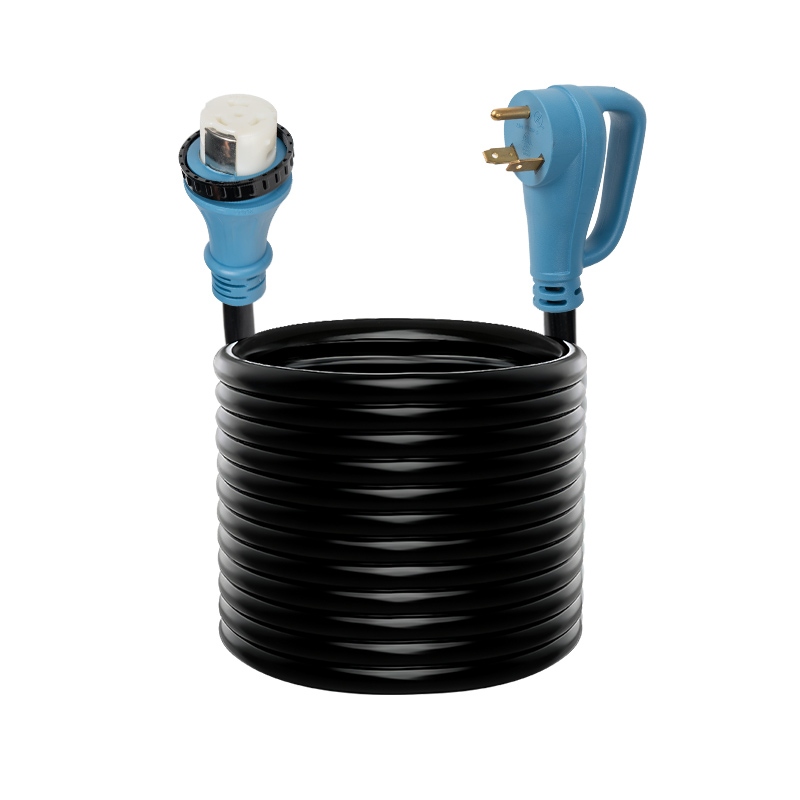
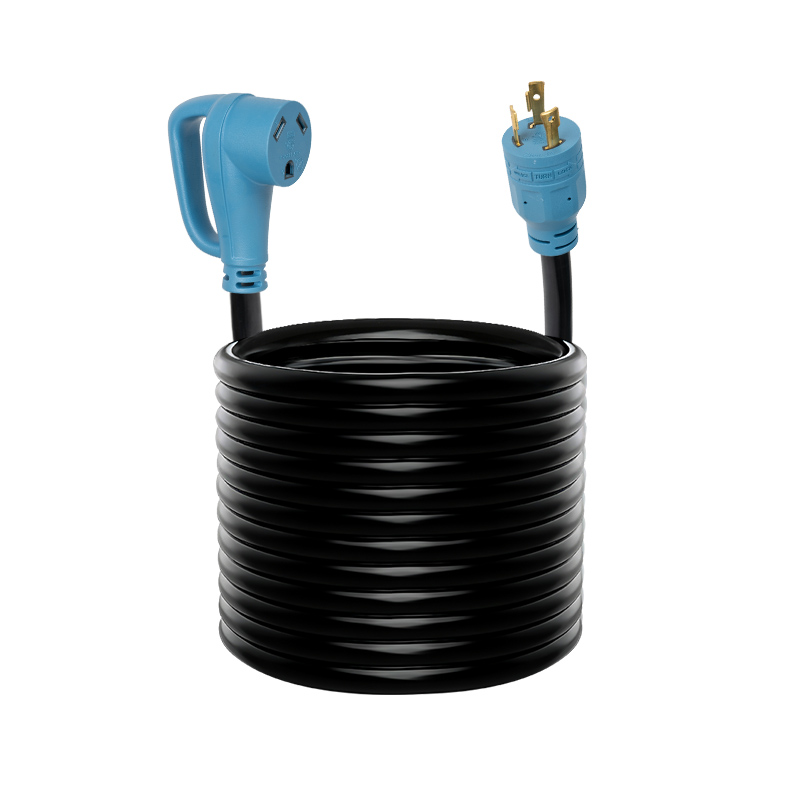
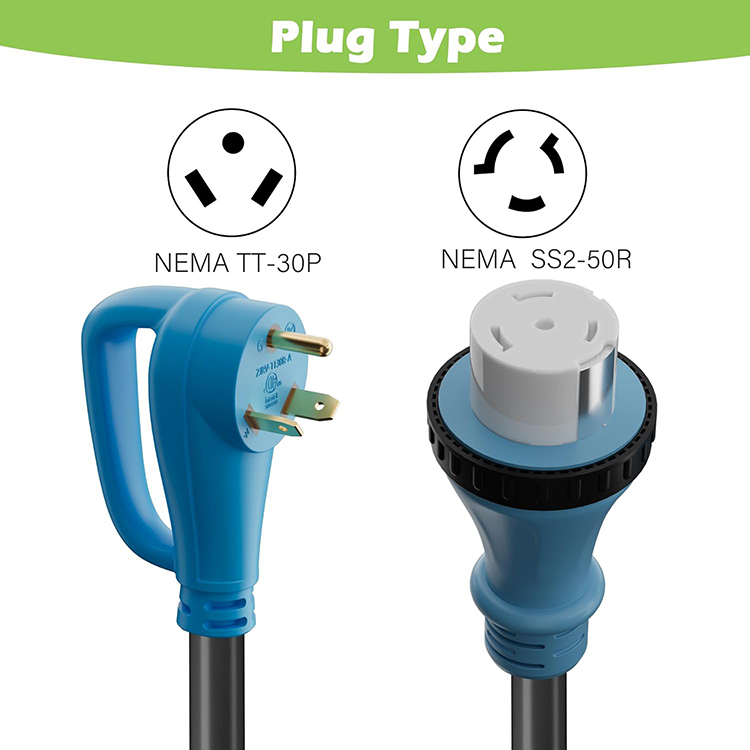 30A to 50A RV Adapter Cord with Twist LockConnects a 50A RV to 30A campground or home outlets; verify blade spacing, neutral, grounding, and current-limit instructions before use.View Product →
For a 50A RV connecting to a 30A pedestal, the adapter should be treated as a current-limiting interface. The buyer should confirm that the RV’s energy-management system or user instructions prevent sustained overload, and that the adapter’s conductors, terminals, and housing are rated for the intended current and outdoor exposure.
The Specification Sheet That Prevents Rework
A useful RV adapter specification is short enough to review in a meeting and specific enough to inspect at incoming quality control. The table below shows the minimum fields we recommend before a sample is approved.
| Field | What to verify | Why it matters |
|---|---|---|
| Plug standard | Exact NEMA designation for male and female ends, including TT-30P, 14-50R, L5-30P, L14-30R, 5-15R, or 5-20R. | Prevents blade-pattern mismatch and returns from campgrounds or installers. |
| Electrical rating | Amperage, voltage, poles, wires, and whether the adapter is intended for 125V only or 125/250V service. | A 30A adapter must not be presented as a way to obtain 50A capacity. |
| Conductor and terminal | Conductor gauge, terminal material, crimp or screw termination, strain relief, and contact plating. | Contact heating and loose terminations are common failure points in repeated plug-in use. |
| Housing and ingress | Connector body material, cable jacket, outdoor suitability, and resistance to moisture and UV exposure. | Campground use exposes adapters to rain, dust, dragging, and repeated handling. |
| Certification and marking | Certificate scope, file number where applicable, label content, and traceability to the production lot. | A certificate for a related cord family is not automatically evidence for the exact adapter. |
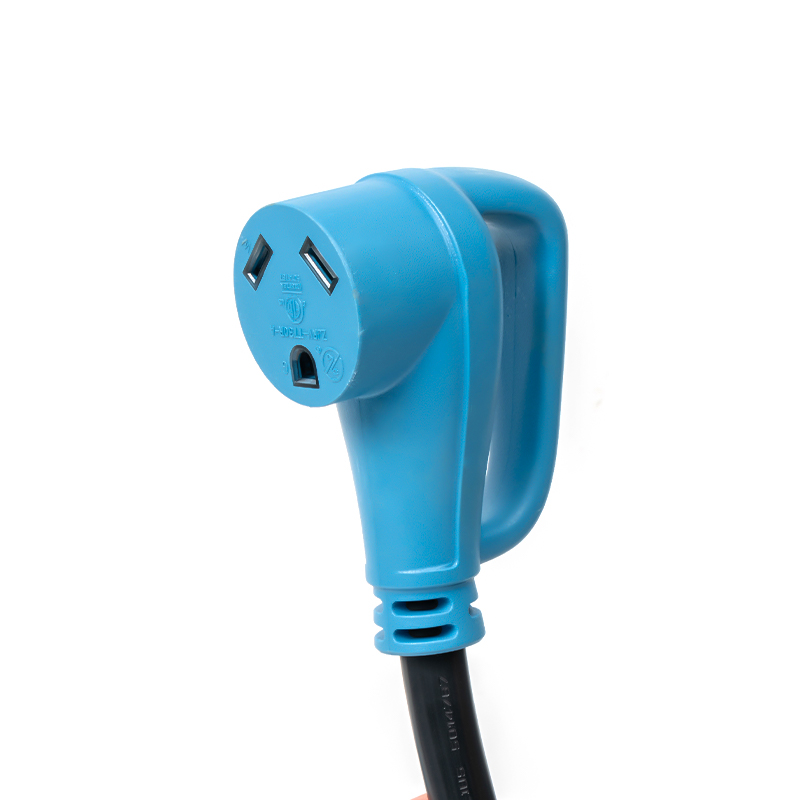
 50A to 30A RV Dogbone Adapter, 14-50P to L5-30RTrailer and camper power adapter converting NEMA 14-50P male to L5-30R female; confirm conductor gauge, jacket type, and current-limit marking.View Product →
The 50A-to-30A dogbone is a good example of why the table matters. The assembly may be physically compact, but the buyer still needs the exact 14-50P and TT-30R configuration, the conductor gauge, the jacket type, and the marking plan. A short adapter is not an excuse for an underspecified conductor or an unmarked current limit.
Certification Is a Scope Question
For North American RV and generator accessories, c(UL)us and ETL marks are common procurement checkpoints; CE is relevant for European channels. The audit question is not simply “Do you have a certificate?” It is “Does the certificate scope cover this plug family, this rating, and this production location?” Ask for the certificate and the associated test report summary, then compare the model designation, ratings, and construction details with the sample you are approving.
Our quality system is ISO 9001, and our product range includes NEMA 5-15P, 5-20P, TT-30P, L5-30, L14-30, 14-50, and related connector families, along with c(UL)us, ETL, and CE certifications. That breadth helps, but it does not replace a line-by-line review of the exact adapter. A factory that can show incoming inspection records for terminals and housings, in-process continuity checks, and final hi-pot or dielectric testing is easier to qualify than one that only sends a certificate image.
Pay attention to labeling as well. The adapter should identify the plug types, the current and voltage rating, the manufacturer or private label, and any caution about not exceeding the pedestal or RV limit. A molded label that survives outdoor handling is part of the product, not packaging decoration.
Field Failures Start at the Contact Interface
Most RV adapter problems do not begin with a dramatic electrical event. They begin with a loose blade, a worn pedestal receptacle, a cable pulled at an angle, or moisture sitting in a connector body. The result is resistance, heat, discolored plastic, and eventually an open circuit or a melted contact. Buyers should inspect the interface, not just the cable.
Illustrative inspection priority based on common field checks; not a statistical sample.
- Check ground continuity end to end and confirm that the neutral and ground paths match the intended plug configuration.
- Inspect terminal crimp quality and pull strength; a terminal that moves inside the housing will heat under load.
- Verify strain relief at both ends, especially on 1 ft and 2 ft dogbones that are frequently pulled out by the cable.
- Confirm the housing material and jacket are suitable for outdoor storage, UV exposure, and repeated connect/disconnect cycles.
- For Y splitters, confirm the total load rating and the limitation of each branch; plug compatibility alone is not a load calculation.
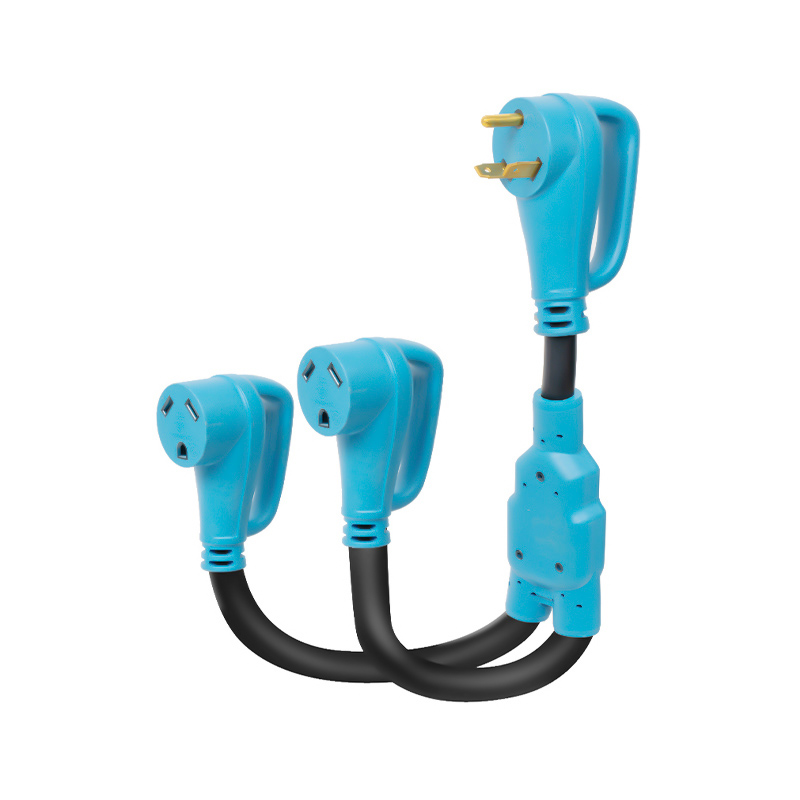
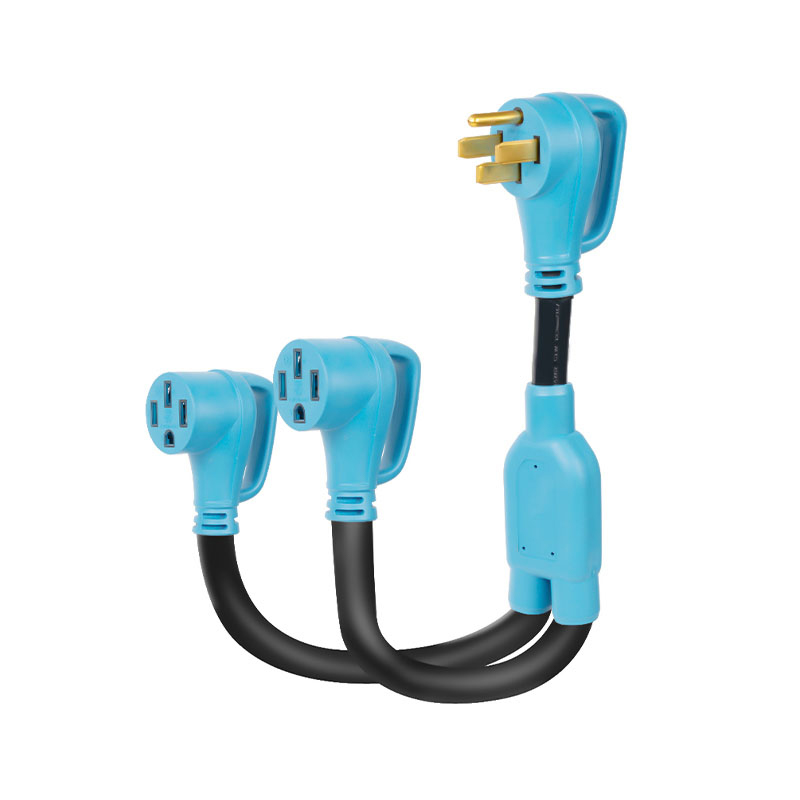
 TT-30P Y Splitter Adapter Cord for RV and EVSplits one 30A TT-30P feed to two TT-30R receptacles for RV or EV loads; define combined current limit and branch receptacle types.View Product →
A TT-30P Y splitter is useful when two lower-current loads need to share a 30A pedestal feed, but the buyer should define the maximum combined load and the branch receptacle types. If the application mixes RV and EV loads, the user instructions should make the total-current limit obvious.
Sourcing Checklist for an RV Adaptor Factory
Use a sample approval process that mirrors the field. A fit check on a new pedestal is not enough; the adapter should also be checked against a worn receptacle, a cable pull, and a short load test where safety permits. Then translate the approved sample into written specifications and golden samples.
- Confirm the exact male and female NEMA configurations, voltage, amperage, poles, and wires on the drawing.
- Require a certificate scope that covers the adapter family and rating, plus the label artwork and location.
- Review conductor gauge, terminal material, contact plating, strain relief, and housing material against the use environment.
- Ask for continuity, polarity, ground-path, and dielectric test records, not only a final visual inspection.
- Validate packaging, master-carton marking, barcode content, and private-label requirements before mass production.
- Define change control: plug supplier changes, housing material changes, and conductor changes should require written approval.
For related cord-length, gauge, and application decisions, this RV extension cord overview is a useful companion to the adapter specification. It helps separate the adapter’s current-limiting role from the extension cord’s voltage-drop and handling considerations.
A Factory Audit Agenda That Reveals Real Capability
A two-hour audit should answer three questions: can the factory control the plug interface, can it repeat the assembly, and can it prove the result? Start at incoming inspection for terminals, housings, and cable. Move to the crimp or termination station and check whether the operator has a visual standard and a pull-test or continuity check. Then review final test records and label control.
Ask to see the production flow for a 30A TT-30 adapter and a 50A 14-50 adapter side by side. The plug families differ, but the control points should be equally clear: correct blade set, correct terminal orientation, correct conductor length, correct strain relief, and correct label. A factory that can explain those differences without reading from a brochure is usually better prepared for repeat orders and engineering changes.
Finally, confirm capacity and lead time against your forecast. RV adapters are seasonal in many markets, and a supplier that can mold, assemble, test, and pack the same family across 30A and 50A variants is easier to manage than one that sources finished assemblies without visibility into the critical operations.
The lowest-risk RV adaptor factory is not the one with the widest photo gallery. It is the one that can name the plug standard, state the current limit, show the test evidence, and keep the approved construction unchanged after the order is placed. Start with the pedestal and RV inlet, write the specification around that interface, and let price follow the verified build.


- [email protected]
- +(86)-0574-62162605
- +(86)-137 0584 5290
- No. 5-2, Yaobei Avenue, Simen Town, Yuyao City, Ningbo, Zhejiang Province, China
Copyright © NINGBO ZHENJIA ELECTRIC APPLIANCES CO.,LTD. All Rights Reserved. Custom Temporary String Light Manufacturers
